Protecting Lives & Property with Intelligent Automation
Revolutionizing fire safety for Sri Lanka through cutting-edge robotics and AI
The Autonomous Smart Firefighting Robot is a self-designed and self-learned solution specially suited for Sri Lankan environments, where human access during fires can be dangerous or limited. This intelligent system covers electronics, electrical systems, embedded programming, and robotics to create a comprehensive firefighting solution.
The robot is divided into two main functional parts working together through ESP32-to-ESP32 wireless communication: a Smart Mobile Firefighting Vehicle for navigation and movement, and a Fire Suppression and Water Management System for extinguishing fires. The project aims to reduce risk to human firefighters, respond quickly to fire incidents, and provide a low-cost, intelligent, autonomous firefighting solution adapted for real-world use in Sri Lanka.
AI-assisted detection and suppression
Independent mobility & firefighting control
Targeted fire suppression
Reduces human firefighter risk
Key components, technologies, and challenges overcome
Track our progress and latest developments
Built the foundational system with Part 1 (Smart Mobile Firefighting Vehicle with chassis, 4 DC motors, and ESP32) and Part 2 (Fire Suppression System with water pump, 5L tank, sensors, and cooling). Established ESP32-to-ESP32 wireless communication between both systems.
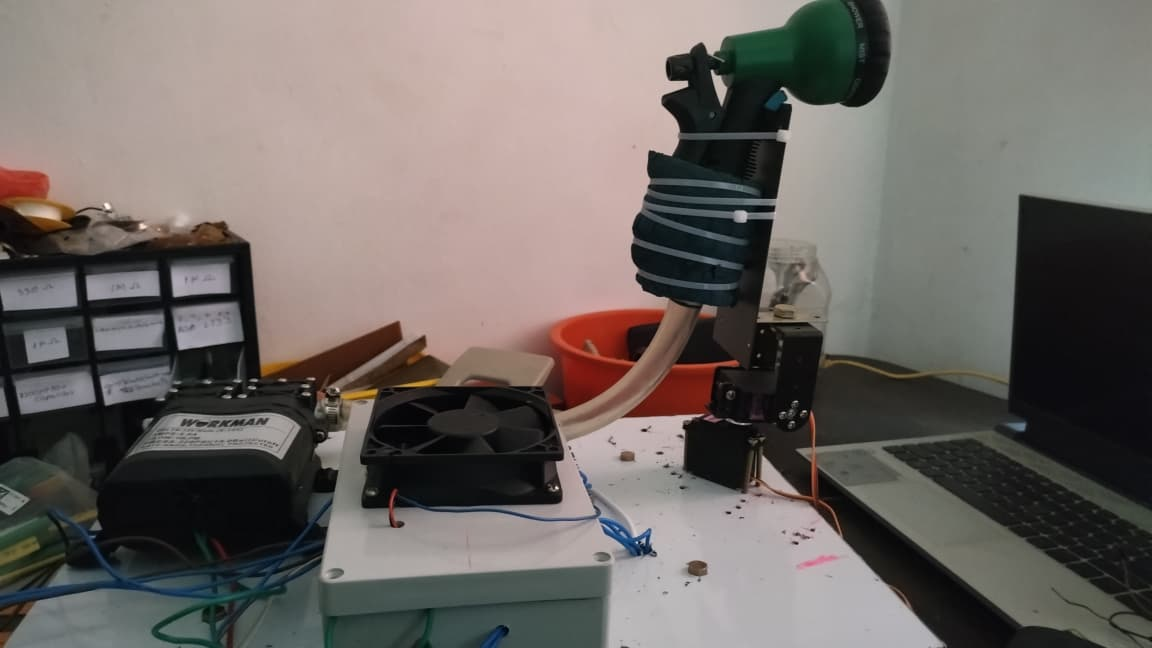
Successfully completed the X-Y axis servo motor integration for precise water nozzle control. This allows accurate rotation and aiming of the water gun, enabling targeted fire suppression from multiple angles.
Currently developing an intelligent AI assistant with voice detection, Speech-to-Text (STT), and Text-to-Speech (TTS) capabilities. The AI assistant can access all sensor data, provide real-time information to users for firefighting decisions, and has full system control and monitoring capabilities. It enables voice-controlled operations, intelligent status feedback, and acts as a comprehensive command interface for the entire firefighting system.
Upgraded electrical system for enhanced safety and reliability
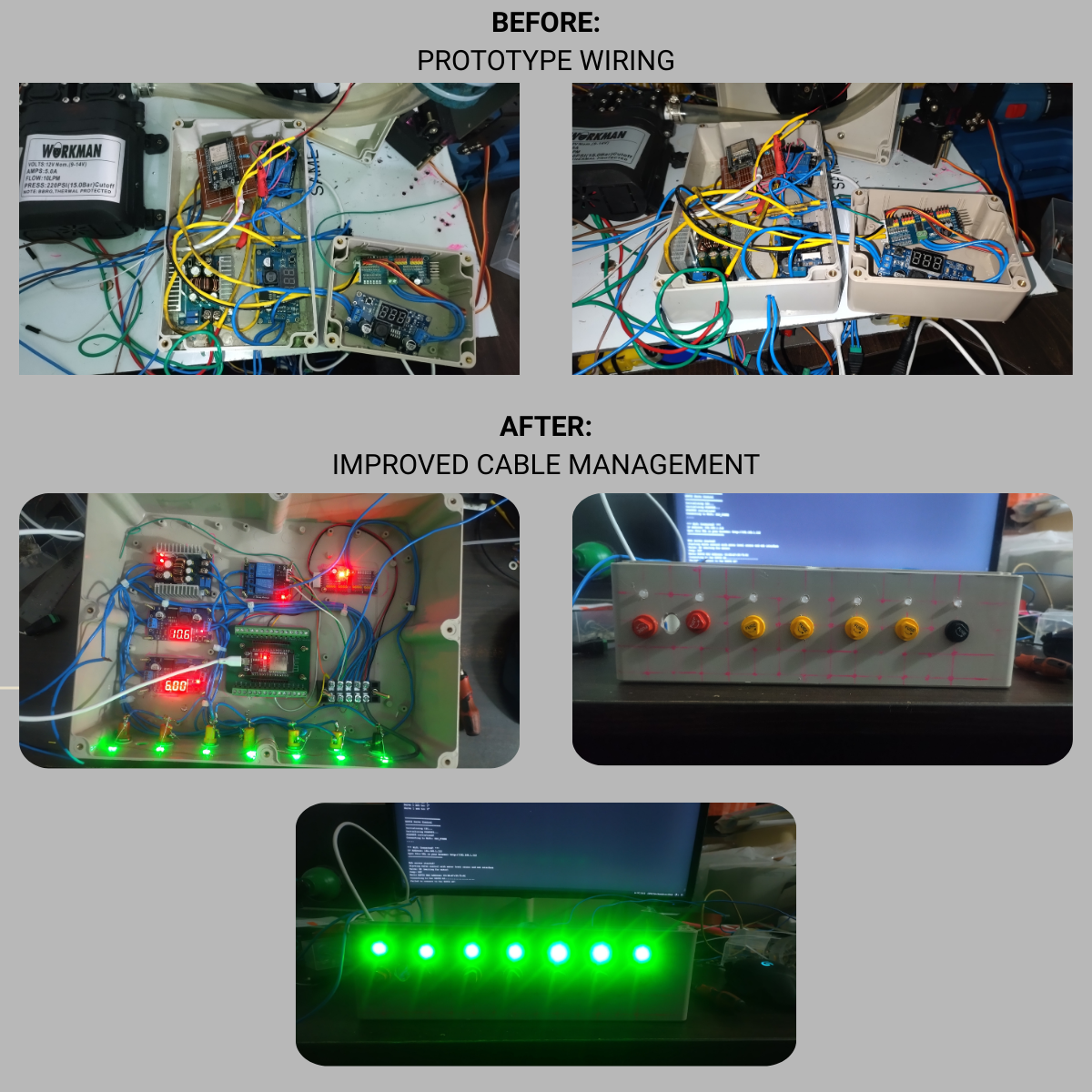
Latest hardware upgrades focusing on system control and operational safety
A weatherproof white enclosure mounted on the mobile platform houses the complete power distribution infrastructure including voltage regulators, fuse panels, cooling systems, microcontrollers, switches, and monitoring displays. This centralized approach ensures efficient power management and circuit protection throughout the system.
This iteration emphasizes robust electrical architecture, serviceability, and field-proven dependability for sustained firefighting operations.
Next phase will integrate a camera module to visually identify fire instead of manual control. Computer vision algorithms will enable the robot to detect flames and heat signatures autonomously.
Final phase will implement agentic AI with LangChain (memory) and LangGraph (decision-making). The system will automatically detect fire location, rotate servos toward the fire, and spray water precisely without human intervention.
Visual documentation of our development journey
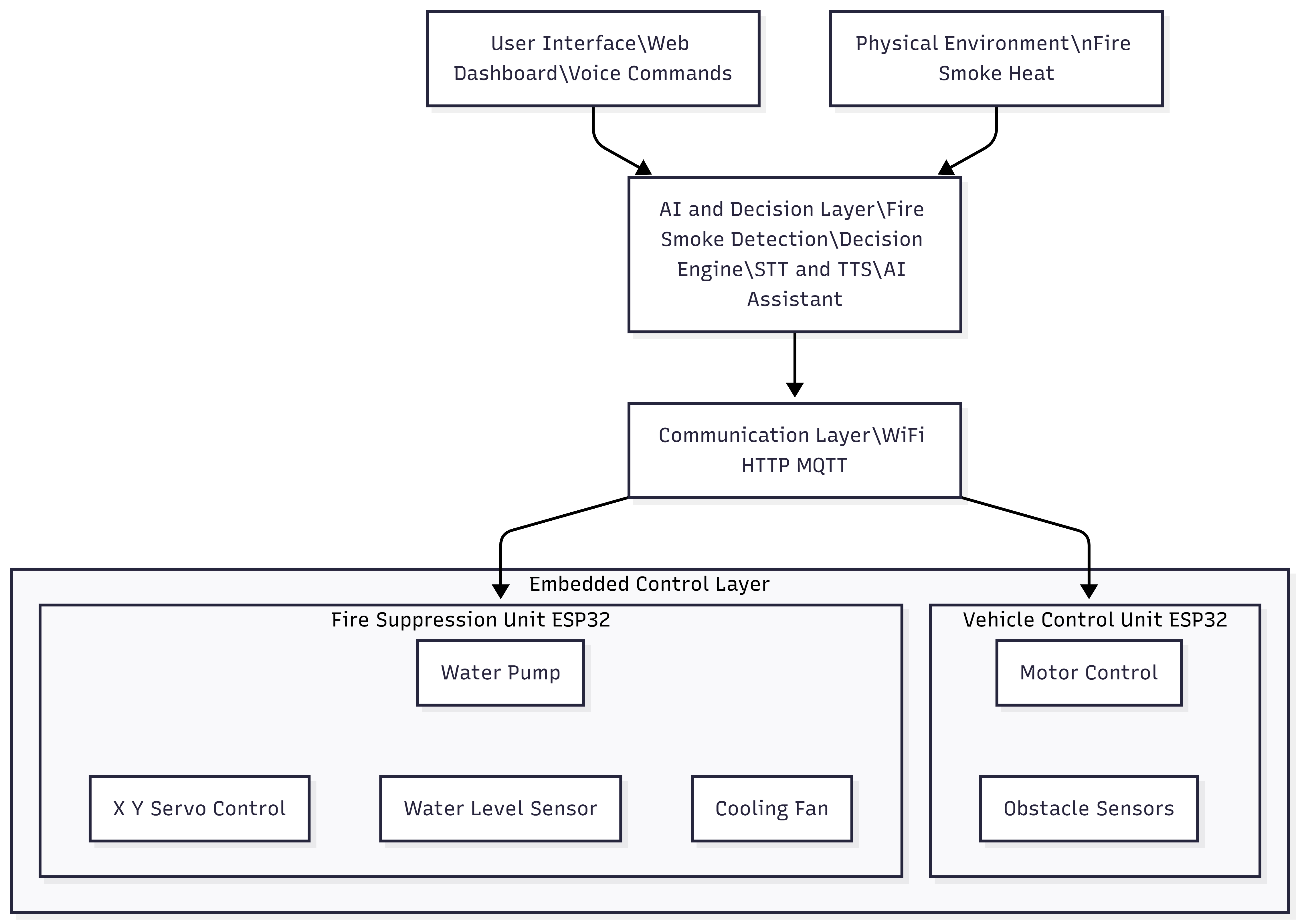
In-depth specifications and architecture
💡 Click on the diagram to view larger version
The robot employs a distributed dual-ESP32 architecture where Part 1 (Mobile Vehicle) handles movement and navigation, while Part 2 (Fire Suppression System) manages water pumping, spraying, and monitoring. Both ESP32 controllers communicate wirelessly to enable synchronized firefighting actions with improved reliability and response time.
* This diagram will be updated in future versions
Let's work together to make Sri Lanka safer
Interested in collaboration, investment opportunities, or deploying our firefighting robot? We'd love to hear from you!